5 Secrets Adult Musicians Use to Overcome Fear and Perform Live.

Bruce Whitehead
Bruce had over 45 years of experience in the Defense/Electronics Industry with a diverse background of executive responsibilities including General Management, Strategic Planning and Development, Systems Engineering, Business Development, Programs Management, and Mergers & Acquisitions.

How Adult Learners Are Reigniting
Their Passion for Music
For many adult music students, music begins as something deeply personal. Maybe it started with childhood piano lessons, singing in a school choir, or finally buying the guitar you always wanted to learn. What once felt like a hobby slowly becomes something more meaningful, a creative outlet, a form of self-expression, and a way to reconnect with yourself.
But eventually, many adult learners begin asking the same question:
“Could I actually perform?”
That thought can feel exciting, inspiring, and terrifying all at once.
The good news is this: you do not need to be perfect to become a performer. In fact, many adult musicians are discovering that performing is less about perfection and more about connection, confidence, and growth.
Why Adult Learners Often Struggle With Performing
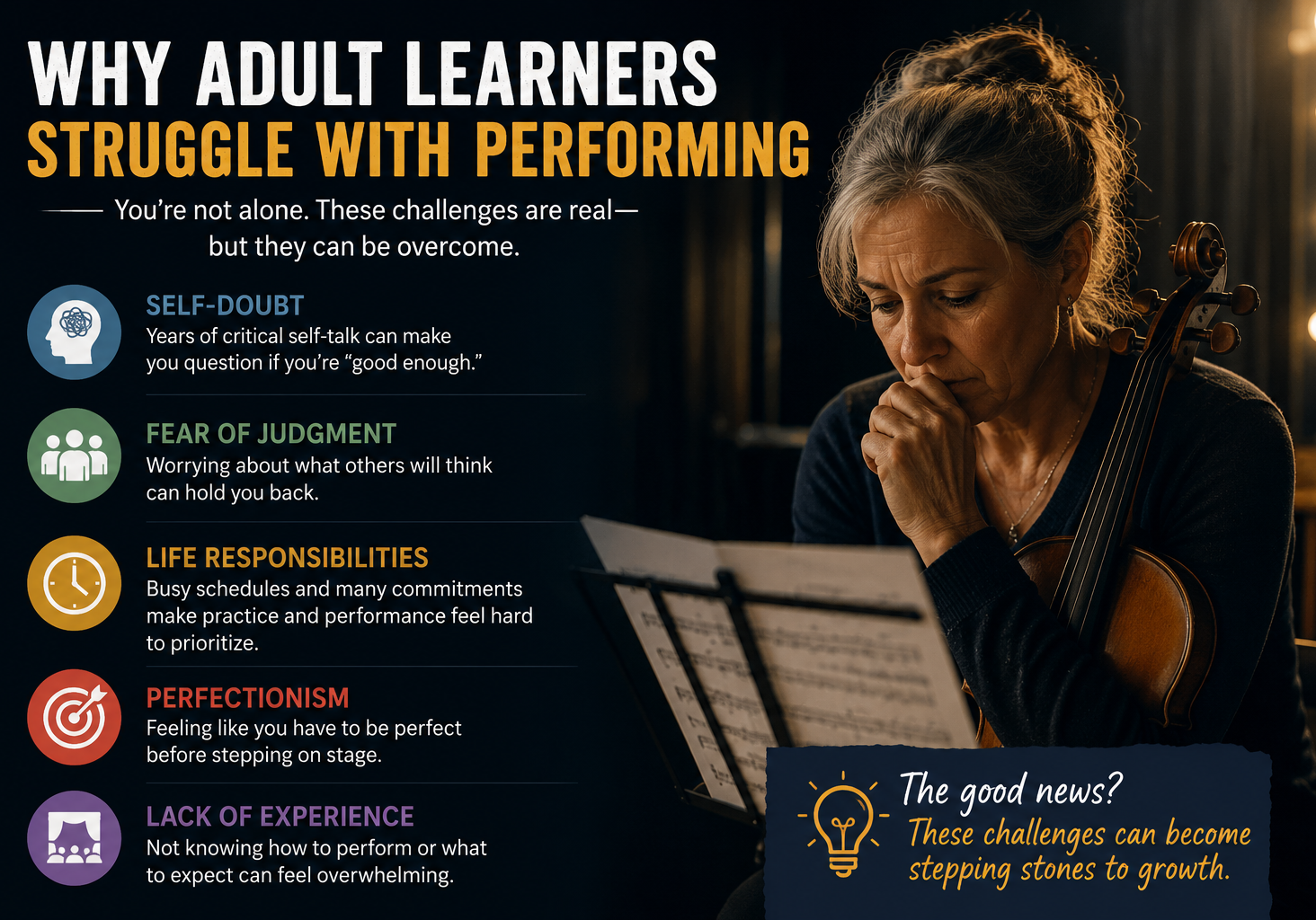
Adult learners face challenges that younger students often don’t. Many adults carry years of self-criticism and fear of judgment into their musical journey. They compare themselves to professionals or believe they are “too late” to start performing.
The reality is that most adult music students are not trying to become concert soloists. They simply want to share something meaningful.
Performing as an adult is not about proving your worth. It is about allowing yourself to experience music more fully.
Once students shift their definition of success, everything changes.
A successful performance is one where you:
- Express emotion
- Connect with the audience
- Stay present in the moment
- Share your love of music
Start Small and Build Confidence Gradually
The transition from hobbyist to performer rarely happens overnight. Confidence is built through small experiences repeated consistently over time.
One of the best ways to grow as an adult musician is to create manageable performance goals.
Simple Ways to Begin Performing
- Play for family or close friends
- Attend a local open mic night
- Perform during a studio recital
- Share a recording online
- Participate in a community ensemble or church group
Each small performance helps reduce fear and build familiarity with being heard by others.
Many adult students make the mistake of waiting until they feel “ready.” But confidence usually comes after experience, not before it.
Stop Focusing on Perfection
- Perfectionism is one of the biggest obstacles adult musicians face.
- When students focus too heavily on mistakes, they often lose the joy that made them fall in love with music in the first place.
- Learning to recover from mistakes gracefully is part of becoming a musician.
Some of the most memorable performances are not technically perfect — they are simply honest.
Ironically, audiences rarely remember small imperfections. They remember emotion, authenticity, and energy.
Record Yourself and Track Progress
One powerful strategy for adult learners is recording practice sessions and performances.
At first, it can feel uncomfortable. But recordings help students:
- Hear progress objectively
- Identify strengths and weaknesses
- Build performance awareness
- Become more comfortable being heard
Over time, students often realize they are improving far more than they thought.
Growth in music is usually gradual, and recordings provide proof that your hard work is paying off.
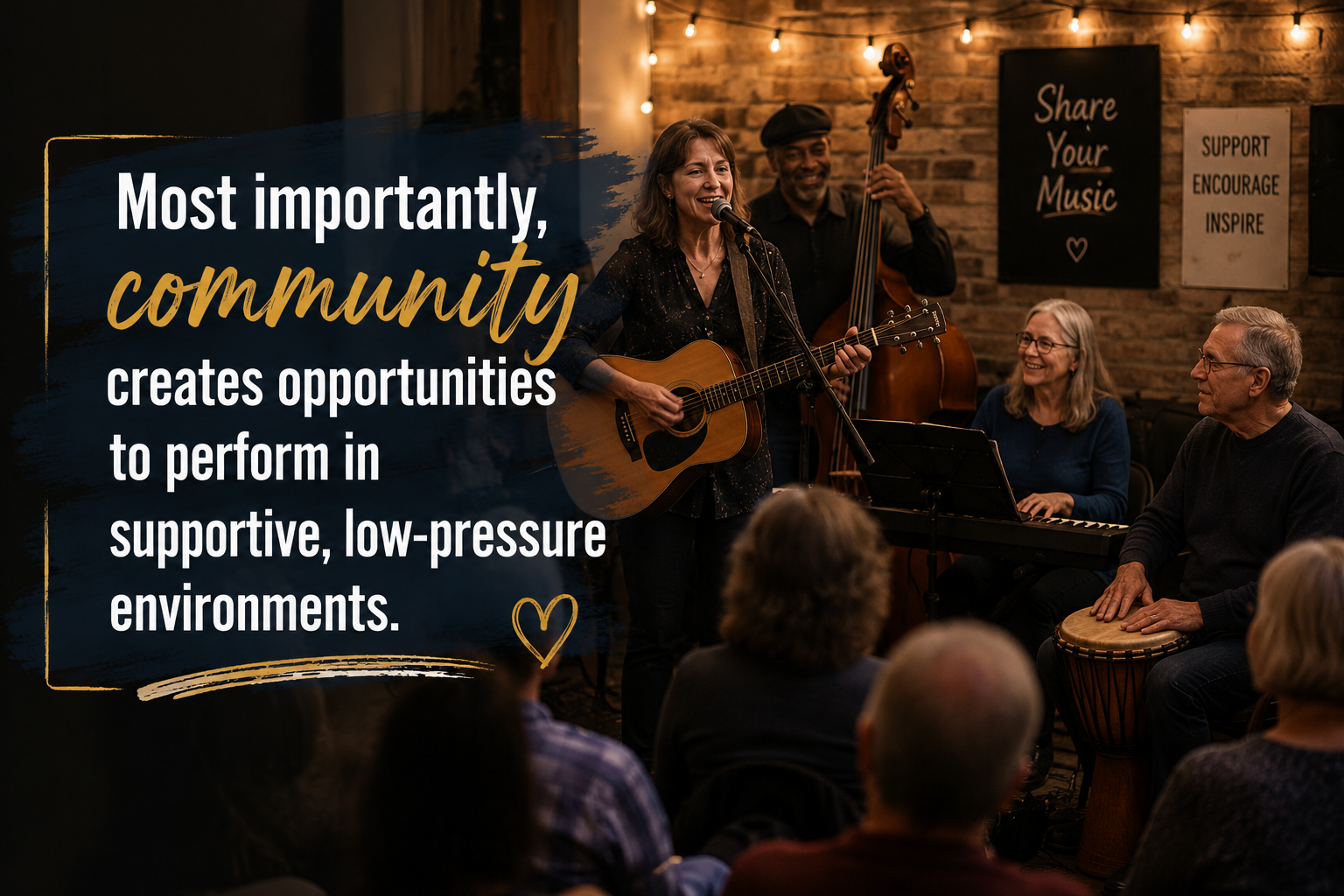
Find a Musical Community
Music was never meant to be experienced completely alone. One reason many adult learners stop progressing is isolation. Practicing by yourself without encouragement or accountability can eventually drain motivation.
Finding a musical community changes everything.
Great Places for Adult Music Students to Connect
- Play for family or close friends
- Community choirs
- Local bands or orchestras
- Jazz ensembles
- Adult group classes
- Workshops and masterclasses
- Online music communities
- Virtual performance groups
Being surrounded by other adult learners helps normalize the challenges of learning later in life. It also reminds students that they are not alone in their fears or struggles.
The Importance of Mentorship
A strong mentor can dramatically accelerate an adult student’s confidence and growth.
Adult learners often benefit from instructors who understand not only music, but also the emotional side of learning as an adult. The right mentor helps students:
- Set realistic goals
- Develop consistent practice habits
- Overcome performance anxiety
- Build confidence gradually
- Rediscover joy in music
Good mentors do more than teach notes and technique. They help students believe they belong in the musical world.
That encouragement can make all the difference.
It Is Never Too Late to Perform
One of the most beautiful things happening in music education today is the growing number of adults returning to music later in life.
Some are rediscovering abandoned dreams. Others are beginning for the very first time. Many are finally allowing themselves permission to do something purely because they love it.
The stage does not belong only to professionals.
It belongs to anyone willing to share their music.
Whether your first performance happens at an open mic, a small recital, or simply in front of a few friends, taking that step is an accomplishment worth celebrating.
Because the moment you stop hiding your music and start sharing it, you are no longer just a hobbyist.
You are a performer.
Top Blogs







Related Success Stories